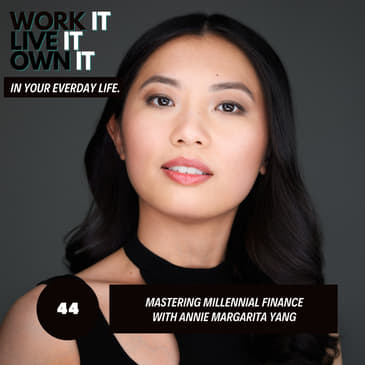

In this episode of Work it, Live it, Own it! SaCola Lehr sits down with Annie Margarita Yang, an expert in millennial finance and author of "The Five Day Job Search." They discuss the challenges millennials face in achieving financial stability and the American dream, with a focus on job search strategies, such as applying to 50 jobs a day with a highly targeted resume. Annie emphasizes the importance of showcasing impactful accomplishments rather than just job duties. She also offers advice for educators transitioning careers and entrepreneurs balancing business with family life, drawing inspiration from figures like Ruth Bader Ginsburg.
The importance of focusing on millennials (00:00:00)
Discussion on millennials' financial challenges and beliefs about the American dream and financial milestones.
The strategy of applying to 50 jobs a day (00:02:59)
Annie's strategy for job searching, including the shock factor and her success with this approach.
Creating a standout resume (00:06:27)
Annie's advice on crafting a resume that showcases accomplishments and stands out to potential employers.
Transitioning to a new career (00:10:03)
Practical advice for transitioning to a new career, including finding a specific job title and analyzing job listings.
Balancing a full-time job and building a business (00:14:43)
Annie's personal philosophy and advice for balancing a full-time job with building a business, including setting hourly rates.
Prioritizing schedule and balancing parenthood with entrepreneurship (00:19:45)
Discussion on prioritizing schedules and balancing parenthood with starting a business, with insights on individual situations and inspirations from others' experiences.
Making Jewelry at Home (00:23:25)
Annie shares the advantage of being able to make jewelry at home, contrasting with her own childhood experience.
Mindset Shifts for Time Management (00:24:27)
Annie discusses the importance of mindset shifts in managing time and how she schedules her activities to maximize productivity.
Balancing Work and Personal Time (00:25:51)
The hosts discuss the importance of time blocking for work and personal activities, emphasizing the need for balance.
Staying Connected with Annie (00:27:36)
Annie provides her website and announces her presence on TikTok, inviting listeners to follow her for more insights.
Rapid Fire Questions (00:28:48)
Annie shares her financial advice for early 20s and her favorite way to unwind after a hectic day.
Engagement and Feedback (00:29:29)
The hosts encourage listeners to share their insights and experiences from the episode and provide ways to connect with Annie.
Connect with SaCola: https://workitliveitownit.com/
Follow SaCola on Instagram: https://instagram.com/ workitliveitownit
Subscribe to Work it, Live it, Own it! On YouTube: https://bit.ly/2lxB1TS
Read more about SaCola’s real estate story: https://bit.ly/40T3dnt
Speaker Lehr** ((00:00:00)) - - Welcome to Work it, Live it, Own it! show that explores how to upgrade your lifestyle through life lessons, real estate and entrepreneurship. Here's your hostess. SaCola Lehr. Hello everyone, and welcome to another episode of Orchid Living. On it. Are you a millennial who faces a challenge of balance and finance? Well, look no further question. No longer. Because today on this particular episode, we're going to focus in on some key strategies for millennials. We're going to talk about some personal, impactful moments and practical tips for balance. I am joined today with a special guest, Annie Margarita Yang. Now, Annie is a leading voice in millennial finance. She's known for her award winning bestseller, The five Day Job Search. Now, Annie's candid and practical advice stands out because she addresses financial hurdles faced by millennials. Her approach is witty and relatable, and now she's based in Boston alongside her husband, and she is able to seamlessly blend her professional expertise with passion for piano, adding depth to her multifaceted persona. Welcome Annie to the working living community.
Speaker Lehr** ((00:01:26)) - - I'm happy to have you here today.
Speaker M. (Yang**) - (00:01:29) - SaCola. Thanks for having me on.
Speaker Lehr** ((00:01:31)) - - Not a problem. So, Annie, I have to ask you. Why millennials? Why is your primary focus? Millennials.
Speaker M. (Yang**) - (00:01:40) - Because I'm a millennial myself. I actually turned 29 this week, so I'm right there. But I also care about Gen Z as well, because Gen Z is the generation where right now they're the ones going to college and coming out, and they're wondering how they can progress in their career as well. But I'm mainly focused on millennials because they seem to have this belief that the American dream is dead, and they think a lot of financial milestones are pretty much impossible to hit, such as buying a house, having kids, you know, all of those stuff, buying their car. They seem to like have this philosophy that it's not possible and that their parents had life better.
Speaker Lehr** ((00:02:27)) - - Wow. Okay. Thank you for bringing that perspective, because I've worked with millennials myself as a former classroom teacher. So I had no idea that a lot of this is resting on their shoulders right now.
Speaker Lehr** ((00:02:43)) - - So can you share with us a key strategy from your book, the five day job search that has resonated with most of your audience, especially for those who are trying to balance a full time job while building their own business.
Speaker M. (Yang**) - (00:02:59) - So one of the things that I talk about is the importance of applying to 50 jobs a day. A lot of people like you, they had the similar visual reaction that I'm seeing from you right now. The shock. Right. And in fact, I made a video on YouTube a few days ago about why if you want to have a successful job search, you need to apply to 50 jobs a day and the video is gaining views and commenters are like, this isn't possible. You know you need to have a customized resume and customized cover letter for every job. You can't just do the easy apply button, but that's basically what I've been doing, right? Like, I would write a highly targeted resume that speaks to employers and showcases my accomplishments. And then I would hit the easy apply button and spend only like one minute applying to each job.
Speaker M. (Yang**) - (00:03:52) - So that's basically a one hour a job like a day search. Right. And then after a whole week of doing that, I'll have applied to about 300 to 350 jobs already by then. Actually, I've had interviews lined up and then I get an offer. So for three different searches I was able to land a job offer in under a week. So I don't have an accounting degree, but I was applying for accounting jobs. And then in my first search, I got the offer in seven days, and the second search I got in six days. And then in the third search I got in five days. So at first I was like, I'm so lucky, I'm blessed by God. But by the time I did it three times, I was like, it's skill. Job search itself is a skill that you can learn, and because I'm able to land these offers so quickly, these hiring managers and the recruiters, they're like trying to act quickly as well to give me an offer. And there's a benefit in that because let's say if you get three offers, you get a lot of room for a negotiation in your favor, right.
Speaker M. (Yang**) - (00:04:59) - And so that's why in between my second job as an accountant and my third one, I went from making $45,000 to $80,000, which was a $35,000 jump. And can you imagine if you can increase your income by $35,000, if you kept your lifestyle the same for the next two years, you can easily pay back your student loan debt, right? Like you can really just take that difference in salary and just pay off your debts and move on with your life.
Speaker Lehr** ((00:05:28)) - - Okay, so one, I'm stunned. First of all, backing up to the 50. Job applications a day. And you mentioned that you have a specific targeted resume where you're showcasing your skills. So now I'm from a different generation, of course, but. I've always been taught when you write a résumé or a cover letter, it should be something where you are showcasing your skills of expertise or your job experience, but you're also wanting to say how you value the company's core values or mention things about the company itself. So when you say showcasing your skills in a resume, are you just completely talking about yourself? This is what I can do.
Speaker Lehr** ((00:06:17)) - - This is what I can offer and bringing to the table. What does that look like for someone, a millennial or Gen Z applying for jobs? Right now?
Speaker M. (Yang**) - (00:06:27) - I've looked at people's resumes and they come to me telling me that their resume is already good. It looks like any other resume. It doesn't stand out. It looks like basically a rehash, a mashup of the job listings of the jobs that they've successfully landed in the past. So let's say you're a classroom teacher. It looks like a rewrite, a rephrasing of the job listing that you apply to for that teaching position that ends up being on your resume. Right. I'll be very honest. This is what I see over and over again. And that's why if you cut off the contact information at the top, you can't tell that it's socially right, like for example. Or it's any like you wouldn't be able to tell because it all just like kind of blends in because everyone's doing that. They don't really understand what accomplishment means. And so one of the things I tell people is what they struggle with is they don't understand what accomplishment means.
Speaker M. (Yang**) - (00:07:25) - Like, for example, I work in accounting, all accountants in my role, we all pay bills. We all enter and process bills, we pay the bills. Okay, so I looked at like, um, accounting resumes of other people who applied for my job and they all say the same thing. I paid bills, I'm like, yeah, but I did that to, you know, like the employer is not going to be able to tell that I'm a better accountant than someone else, right? So I write things like I shortened bill processing time down from five days, which is who I replaced in the past, versus I can process it in two hours, shortened it from five days to two hours, or I managed to find $50,000 in a bank account that belonged to the company that the company now has available to spend things like that, you know, like, uh, things that go beyond just the job duty, if you know what I mean. I actually, I did write a resume for a teacher.
Speaker M. (Yang**) - (00:08:23) - So of course, like all teachers do the same thing, right? You guys all plan out your curriculum, you teach the kids, you have to grade exams and and all sorts of stuff. Right? So the difference to make the teacher look a bit more a different is like, well, how many students did you teach? Um, what was the background of these kids? Right. Like demographic wise? Um, high school, middle school, you know, um, subject matter like those details, they matter in the resume because it kind of like it communicates more to the employer. Um, the context in which you worked, you want to really show that kind of adaptability. I think that's the important part, that you can adapt to any environment, and you can communicate that in your resume by adding those numerical details.
Speaker Lehr** ((00:09:09)) - - I think that's important because even as a veteran educator myself, you're right. We we all pretty much done the same thing. Even as a school librarian, I pretty much done anything that any other school librarian has done.
Speaker Lehr** ((00:09:24)) - - But for my educators who are leaving, especially even millennials, they started out maybe even in a teaching career, and they want to make a shift out to something totally different. You said something that you applied for accounting jobs and you weren't even an accountant. So any advice or tips that you have for those who are trying to transfer from one area of expertise and they want to apply to another area of expertise, any type of impactful insight that you can share with, especially my educators who are trying to find something else in another field.
Speaker M. (Yang**) - (00:10:03) - Yeah. So what you can do a very practical piece of advice I can give you is, well, first of all, you have to think, what is the job you want to transition into, like that career. You need a very specific title. You cannot just like one person told me, I want to do real estate tax. I was like, but that's not a title, right? Someone else said, I want to do UX. And then I said, but UX is an industry that's not a title.
Speaker M. (Yang**) - (00:10:30) - So we I had to get these people to find a title. Okay. UX designer, that's a title, right? Or um, and the other guy was tax associate. Real estate tax associate. That was the specific title that he needed. So first of all, you have to find a title that you need to apply to. And then you search the title. So real estate tax associate job listing into Google. You open up 20 of the job listings in a new tab. You copy and paste the listing and then you go to ChatGPT for. So you have to pay like $20 a month for ChatGPT for. And then you just say analyze this job listing. What is the employer looking for in their ideal candidate, and what keywords do I need to include in my resume to convey that I am that ideal candidate? And then you paste the you basically just paste the listing and then it will turn out an analysis of the listing for you. You do this 20 times, and then you're going to see over and over again what is important to the employer.
Speaker M. (Yang**) - (00:11:38) - Right. Like for example, my sister, she wanted to, um, work with animals, something related to animals at an animal shelter. I don't know what she wanted. Um, but I, I helped her do the analysis, and the thing that came up over and over again wasn't necessarily education. It was like flexibility that was in every listing flexibility, willing to work weekends, willing to work a different shift every week kind of thing. Right. That's more important to the employer than your qualifications, apparently. Um, so you have to find that pattern, but not just that. So once you found the pattern, what's important, if there are things that in there that fit, like your experience, your past experience, skills, qualifications, fit, of course that needs to be in the resume. And then you can also ask ChatGPT I. I was working as a teacher. I'm transitioning into these roles. These are the roles I want. What are those, um, skills that are easily transferable to this job that I'm applying for? And the answer it gives you is actually really good.
Speaker M. (Yang**) - (00:12:49) - So you can take those answers and somehow work that into the resume. You can even use ChatGPT to write the resume. Um, but I find that the answers are really good to the point where when the interviewer, like in an interview setting, is asking you why are you qualified for this? How how is this transferable? You know, you already can say the right answer, basically, right?
Speaker Lehr** ((00:13:12)) - - Oh, I love it. I love it because a lot of times we think the resume is just designed to get our foot in the door, but your resume has to be good enough for them to even notice and stand out, which is so true. And you have just like videos on social media. You have the first few seconds, 3 to 5 seconds, and they're scanning and skimming, looking through that resume to see what keywords. And a lot of times it's digitized. If it's a big corporation, they're looking for those keywords that stand out for exactly what they're looking for. So thank you for that insightful tip.
Speaker Lehr** ((00:13:44)) - - I'm pretty sure my audience is listening out for that. So take notes, guys, if you are able to or if not, download this episode because it's very important. So let's talk about a little bit more of a personal impact. There are a lot of people, I would say, if not more millennials now, from what I've read, are looking to start their own business. A lot of them are not always looking for the 9 to 5. So. Some have been fortunate to just say, hey, you know, walk away from my 9 to 5, I saved up money and I'm out. But for those who are still balancing a full time job and building a business, it can be a demanding feat. Could you share a personal experience or pivotal moment where applying for a finding, applying your financial strategies made a significant impact on your journey or a journey of someone you have advised?
Speaker M. (Yang**) - (00:14:43) - Yeah. So for me personally, my philosophy has always been, uh, from 9 to 5, I work to pay my bills, and from 5 p.m. to 9 a.m. I work to build my fortune.
Speaker M. (Yang**) - (00:14:55) - So this is what I've always advise people. Um, I don't advise. I love entrepreneurship, I really believe business is a way to build your wealth. Um, but, like people like me, I have financial obligations. Not that I have debt. I don't have debt, but my husband is in school. I have to support him while he's doing his PhD program. So, you know, there's a lot of people in in, like, my shoes. It's not the same as if you're in your, uh, early 20s with very few debt obligations. You're single. Right. So you don't have anyone to, uh, who's depending on you other than just yourself. So that's a very different situation, right? A lot of millennials these days, um, you guys are older than me. I'm on like, the low, like the lower end of millennials. So actually millennials are older than me. So by then a lot of these guys have already paired up. Right. Or have kids at this point.
Speaker M. (Yang**) - (00:15:49) - Um, so either one, you build your business while your spouse is the one working full time that can work. You just have to cut back or two. You have to work full time while building your business on the side, which is what I have to do, right? Um, you can start small. You just need one client. One client to start small. I like to think of it as like, if you're, uh, employed, I think of your employer as your first client, actually. I think of the employer as a client. It's just that the way they pay you is not the same. They pay you for 40 hours. They are your 40 hour client. Another client could pay you for two hours of work a week. For example, a third client could pay you for three hours. It's just the amount of hours each client pays you for, if you get what I mean. Yes. Yeah. So I like.
Speaker Lehr** ((00:16:41)) - - That it's a mindset shift. Yeah. Because a lot of times it's like, oh, I have to go to work.
Speaker Lehr** ((00:16:47)) - - But it's just changing one word. I get to go to work.
Speaker M. (Yang**) - (00:16:52) - Yeah, basically. And and when you have a business on the side, let's say you have five clients, you have to realize you actually have five bosses. Yeah. Your clients are your boss. So if you think like, I don't like 9 to 5, I don't like my boss. Actually, your new clients are your boss. You not only have one, you have five to deal with. So think of that. Okay, um, but I like to at least give this advice. Like, let's say, um, I was doing bookkeeping. A bookkeeper makes about $30 an hour. That's easiest way to charge is to look at your hourly rate at your job. And if you're offering that same service but just simply to clients instead of two employer, you just double the rate. So like if you're getting paid $30 an hour, then you start by charging $60 an hour. If you go with the flat rate flat fee model, you could lose money because you didn't budget the time properly, and then you could end up working for less than minimum wage.
Speaker M. (Yang**) - (00:17:55) - And there's nothing you can do about it, right? If you go and complain to your client. I've worked this many hours at this point is less than minimum wage. You're not going to stay in business. Um, so the best thing to do is just to double the rate. The reason is because, um, you have to take care of your own marketing, your own administrative time. Uh, you have to pay self-employment taxes on that. So you have to pay for your own income tax, and then you have to pay for double the Social Security and double the Medicare that you didn't have to pay. When you're an employee, you only pay half right. So you have to pay the other side as well. So that's why it makes sense to just double the rate.
Speaker Lehr** ((00:18:33)) - - Thank you for sharing that and highlighting that, because a lot of people have the entrepreneurial dream, but they need to know how to break it down. And a lot of people, especially creatives, I have found that they struggle with the business side.
Speaker Lehr** ((00:18:45)) - - If they could just create all day long, they would. But then the business part comes. It can be challenging for them at best. And so knowing, okay, maybe let's look at an hourly rate. And then also if you look at how much time it takes for you to complete a task or an assignment and like Andy is mentioning, double that because you are going to have to pay taxes, self-employed taxes, you're going to have to think about the Social Security, the Medicare, all the stuff that you're 9 to 5 automatically takes out from you to include that. What advice will you have? Because like I said, I have a lot of former some former students I stay in contact with who are millennials. They are adults now. They have children. And I was just talking to one of my former students last week. She's a single mom with a young baby and she is very talented. So her 9 to 5 she's got to do. And when she's at home, she's a single parent.
Speaker Lehr** ((00:19:45)) - - What advice do you have for those who want to start thinking about a business and paying off the debt, but they have a child. What should they prioritize first?
Speaker M. (Yang**) - (00:19:58) - Um, I think they should prioritize their schedule. Mainly. I think that's the most important thing. It really depends on the age of the kid as well. Right? Like it's different if your child is a high school student versus just only five years old. A five year old is is a lot more demanding on your time, right? And you also have to put your kids to sleep before you get to work on your side business as well. Right? So, um, I'm not really sure that's that's a difficult question. You really asked me a difficult question. Everyone has a different life. Like, uh, for example, here in Asian culture. My mom, I don't have kids yet, but my mom has been pressuring me to have kids, and she just says, just have the baby and let them. Then let me have the baby.
Speaker M. (Yang**) - (00:20:40) - I'll take care of the baby for you. You know, you don't even need to have the baby in your house. Just give it to me. So everyone has different parents. In Asian culture, it's like that. The grandparents want to take care of the baby. So, um, I'm not sure everyone's situation is different, but yes, I do want to say, I do want to say, um, if even if you believe it's not possible, I still think it is possible for a single mom because, um, I am so inspired by Ruth Bader Ginsburg when I read her life story of how, when she was attending Harvard Law School, her husband was also a student at Harvard Law School the same year. Right. And they had a baby. And then during their time at law school, they discovered that her husband, Marty, had cancer. So he had to go to his cancer treatments, and then she had to take care of everything, take care of the baby. She had to go to his classes for him to take notes in addition to going to her own classes.
Speaker M. (Yang**) - (00:21:42) - And then after they put the baby to sleep for the night, she was, um, typing up his essays so he would dictate the essays in bed because he had cancer and she would type it up for him. And then only after she was done with his work that she was doing her work, her schoolwork. So, like you can imagine, uh, she's a tough woman, you know, she managed to do it all, so.
Speaker Lehr** ((00:22:08)) - - And there was no voice to text back then. You were typing it on a typewriter back then and just thinking about that. That took a lot of want, commitment, trust, loyalty. And so you touched on a lot of practical tips as far as balance. And that was a wonderful example of that of teamwork. And everybody's situation and scenario is different. You're absolutely right. So I wasn't trying to just give you a hard question, but that was just one. It just so happened my conversation with my former student kind of lined up with what we're talking about today is because she's very talented, and I think she has the great capability of doing something wonderful and exceptional.
Speaker Lehr** ((00:22:59)) - - It's just even if it's just for an hour after you put the baby down for sleep and working on your craft or something you love, enjoy doing, and then building up that inventory. She makes earrings and I bought a couple of her earrings. And so maybe if she can take an hour to have a stuff already laid out early in the morning and work on her craft, well.
Speaker M. (Yang**) - (00:23:25) - I mean, knowing this now, that's that's a the great thing, knowing that now is that she can make the jewelry at home. She can literally do it from home. I mean, my, my mom growing up because my parents were immigrants, I never saw my parents even like when I was five years old, never saw them. It was just me and my cousin who is four years older. So she would just leave me at five years old and my cousin, who's nine years old, just alone at home. Right. Like we literally didn't have anyone know what else to watch us. So that was my childhood growing up because my mom was working all day long, seven days a week.
Speaker M. (Yang**) - (00:24:04) - So, I mean, at least in this person's situation, she can make jewelry at home.
Speaker Lehr** ((00:24:09)) - - Yes, yes, yes. And so any other practical. Mindset shifts that has helped you or others you've worked with manage that delicate equilibrium between the two aspects of life of that 9 to 5 and building a business.
Speaker M. (Yang**) - (00:24:27) - Yeah. Any basically any reason that your brain gives you for why you can't have something is basically just a lie. That is a limiting belief. Um, especially the I'm too busy lie because there are people out there like we all are given 24 hours in a day. We all have the same amount of time. Uh, so why is it that someone else can do so much more in the same hours than us? Right. So it's important to learn from other people. Like, one of the things people ask me how I'm able to do so much and that I've had people call me, I cannot keep up with you. Like, it feels like every time I see you on social media, you're doing something brand new.
Speaker M. (Yang**) - (00:25:10) - It's like now you're learning piano, you're doing this, you're doing that. I'm like, yeah, I guess so. Um, so what I do is like, I have a whole list of things I need to do. I write it all down, um, maybe on Sunday or Monday. And then on that list of things I, I say I'm only going to spend two hours on this. I'm only going to spend 30 minutes on this. And I, uh, I put them into my calendar, so I make sure I don't over schedule or double book. Basically, that's that's what I do. Everything I have to do, I put it in the calendar. Even the time that I have to practice piano or even lunchtime and nap time, that's all in the calendar and I just follow the calendar.
Speaker Lehr** ((00:25:51)) - - Appreciate that because there's balance in your time blocking. And I do the same thing. I have a specific time I for my work, for my business, for podcasting. Even when it comes to editing things or podcasting.
Speaker Lehr** ((00:26:09)) - - And then I carve in personal time as that as well. And it may not be anything dedicated. It just will say vacant time. And that means I can do whatever I want to do in that vacant time. If I want to pamper myself and give myself a mani pedi, I can do that. And so time blocking is an essential skill. And also counteracting that limiting belief. Like Annie said, because our brains tend to go to the negative. Our brain will shut something down because it's new. It's something that's not used to. Our brains are programmed and wired to repetitiveness and the way we traditionally do things. And if we have an idea. I'm starting a business. A lot of people say, well, I don't have time or I don't think it's possible, or a lot of other people are out here doing the same thing. Or how many other people are applying for the same job. Why are you worried about that? The main focus, like Annie has been saying in this conversation, is putting in the work and looking at your accomplishments differently when it comes to applying for jobs, even balancing a full time job in a business.
Speaker Lehr** ((00:27:22)) - - So, Annie. How can we keep up with you with all the wonderful things that you're doing out there? How can we keep up with you? How can our listeners follow you to gain more insight into what you do?
Speaker M. (Yang**) - (00:27:36) - The best way to keep in touch is by heading over to Annie Yang Financial Comm. That's Annie Yang, financial comm. The five day job search audiobook is free. If you go on. Annie Yang, financial Comm click on the audio book link at the top. You can put in your name, your email address to download it. And um, also, the other thing is this year I'll mainly be getting on TikTok, even though my main social media is YouTube, I'm getting on TikTok because I need to get in touch with Gen Z, and that's where they are. That's where they're hanging out. So follow me on TikTok, the username handle is Annie Yang Financial.
Speaker Lehr** ((00:28:17)) - - Okay. Thank you so much. And I just got on TikTok this week. I've been saying, you're doing a podcast.
Speaker Lehr** ((00:28:22)) - - Why are you not on TikTok? And I was like, I don't know, so I understand. Thank you so much. And guys, she noticed she said, free audiobook. So all you got to do is head over to her website. It's free guys. Come on. All it does is take a couple of clicks with your fingers. So, Andy, before I let you go, I have two rapid fire questions for you. You ready?
Speaker (00:28:46) (-) - Yeah.
Speaker Lehr** ((00:28:48)) - - One piece of financial advice you wish you knew in your early 20s. What is that?
Speaker M. (Yang**) - (00:28:56) - You can make however much money you want.
Speaker (00:29:01) (-) - Hmhm.
Speaker Lehr** ((00:29:03)) - - And what is your favorite way to unwind after a hectic day?
Speaker M. (Yang**) - (00:29:10) - Taking a hot bath. And the great thing is, I don't pay any extra for the water because my HOA condo fees include heat and hot water.
Speaker (00:29:22) (-) - Wonderful, wonderful.
Speaker Lehr** ((00:29:25)) - - That's. I guess that's the advantage of living in a big city.
Speaker (00:29:28) (-) - Yes.
Speaker Lehr** ((00:29:29)) - - Thank you so much. So, guys, listen, we want to hear from you.
Speaker Lehr** ((00:29:33)) - - What's one burning question or insight that you've gained from today's episode with Annie Margarita Yang? Also, drop in the comments and let's keep the conversation going. If you want to head over to info@workitliveitownit.com, leave a voice memo for me and Annie. I'm happy to forward that question. On to Annie. But again, she's on TikTok, she's on YouTube and you've got her website. Also, have you tried any of the strategies that Annie Margarita Yang has mentioned today that we've discussed today? Share your experiences or challenges in the comments below, because your story might inspire others in our community. Well, that wraps it up for this episode of Working Live. And on it. As always, don't forget to work it, live it, own it in your everyday lives, guys. Take care.