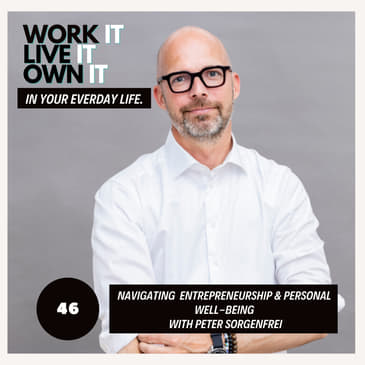

In this podcast episode, host SaCola Lehr and seasoned entrepreneur Peter Sorgenfrei discusses, Peter's journey from quitting an unsatisfying job to founding a successful business with Toyota as his first client. Peter imparts lessons from leading companies in different countries and stresses the importance of cultural sensitivity and a personal touch in business. He advocates for trusting one's instincts in decision-making and discusses overcoming stress-induced health issues through strict personal habits. Peter's whole human approach integrates personal well-being with professional life, as exemplified by his implementation of health programs in a manufacturing setting.. Don't miss out on this empowering video!
Thank you for watching my video! If you enjoyed it, please subscribe to my channel to stay updated on my latest content.
Want to learn how Peter works with forward-thinking leaders? Click here to learn more.
"Sleep and Health Habits": "00:17:44"
"Health and Wellness Program": "00:20:51"
"LinkedIn": "00:23:35"
Books:
"A Sense of Where You Are": "00:24:45"
Stay in Touch:
Connect with SaCola: https://workitliveitownit.com/
Follow SaCola on Instagram: https://instagram.com/workitliveitownit
SaCola (00:00:00) - Welcome to Work it, Live it, Own it! on a show that explores how to upgrade your lifestyle through life lessons, real estate and entrepreneurship. Here's your hostess SaCola Lehr. Have you ever wondered what could happen if you fully embraced and trusted your own answers on your journey to success? Or perhaps you can imagine the powerful impact on your life and business. If you had an independent advisor who truly understood the intricacies of not just your entrepreneurial path, but also guiding you through every up and down twist and turn? Well, I am thrilled to introduce our special guest today, Peter Sorgenfrei. He's a seasoned entrepreneur with a unique approach to personal and professional empowerment. But just to give you a little background about Peter's street cred and business cred, he has been a founder. He is a founder and CEO, not in just the United States, but the United Kingdom and in Denmark for over 15 years, and has been nothing short of remarkable. From humble beginnings of building a business in a garage to leading large teams across borders. Peter has experienced it all.
SaCola (00:01:29) - But what really sets him apart is his realization that success requires something more. It requires a personal advisor with no agenda. So stick with us in this conversation, because this conversation is going to lead you to not only just a happier, but healthier and more productive life while navigating the complexities of building your own business. We're going to focus on three areas today. Entrepreneurial insights across borders, trusting your own answers and navigating the entrepreneurial rollercoasters. Welcome to work at living. Own it. Peter, it is such a pleasure to have you here with us today.
Peter (00:02:18) - Thanks for having me. Pleased to be here.
SaCola (00:02:21) - Thank you. So, Peter. I want to delve a little bit into what led you onto your entrepreneurial journey and how you even got started. You mentioned, I think, in another episode that you started a business even out of a garage. You want to share some of that insight with us, please?
Peter (00:02:38) - Yes. So now, almost 20 years ago, I was in a job that I really didn't enjoy, and so I quit.
Peter (00:02:47) - I had never started anything before that. And as I was sitting there with my two weeks notice, thinking about what was next. Um, I thought about what I would like to do for a living, and I described it, uh, just on a piece of paper. This was just the beginning of everybody having email, right? So, um, I described it and send it out to some past connections of mine saying I would like to work with understanding human behavior, help companies design products and services around that understanding, and then help them to compete better against competitors, which might be doing the same. And so as I was sitting there, I sent it out to these contacts. And very quickly I got my first corporate contract with it was Toyota at the time. So Toyota was my first client. And from there I built a market research competitive intelligence services business based out of New York, uh, Brooklyn, New York. And, uh, and did that over the following six years.
SaCola (00:03:50) - Phenomenal.
SaCola (00:03:51) - Phenomenal. Now, with your extensive experience founding and leading companies in various countries, what are some of the key lessons you've learned about navigating the unique challenges that entrepreneurs face in different business environments?
Peter (00:04:09) - So I'm Danish, uh, coming to you today from Copenhagen. Scandinavians have a fairly direct style. We can talk about anything. We we don't have the same cultural sensitivities that that we do in, for example, the United States or in other parts of the world. Um, so the first thing I had to learn in the United States was the way that we did business and the way that we communicated, uh, was different. Um, that there perhaps was a little more, uh, conversation and a little more discussion than what I was used to from from here in Europe. Um, and then subsequently, I've advised clients in Mexico and Latin America and in Asia. And there again, it's a different way of, of communicating. So this whole cultural sensitivity of the environment that you're in and how you can adjust your personal style without losing yourself, uh, with something that I had to learn very early on.
SaCola (00:05:05) - Right. And I listened to a previous episode that you were on, you were on another show, and you relate an experience of how you actually use some of this approach with a major airline. I believe it was, and it led to great results. Can you share that experience with us?
Peter (00:05:26) - Yes. So this was in in the very early days, you have to imagine a 25 year old, uh, with some hair and not a gray beard, who, uh, essentially called up the chief marketing officer of United Airlines. And what I had learned in the past was you could do that in the United States and suggest a conversation without being ridiculed or rejected outright. Uh, you could never do that in Europe. It's much more formal here. Uh, so I called her and I said, I'm going to be in Chicago anyway, uh, next Thursday. I have some ideas about your loyalty program. Would you mind if I stop by and present them? Now, mind you, in 2024, that sounds a little nuts to do, but.
Peter (00:06:10) - But back then, that's what I did. And she she basically said, actually, no, it's not a good time. I said, well, I'm going to be there anyway. Is there any chance? And she goes, well, meet me at this Starbucks at 715 and um, and let me know by SMS what you're wearing, and I'll come say hi to you and we can chat for a little bit. And so I met her at the Starbucks at 715. Mind you, I was not going to be in Chicago. I literally bought the plane ticket after she said yes. Right. And so I sit there, uh, wait for her. She comes over and the the thing that has served me super well since is this idea of just sharing what you know, without actually expecting anything in return. So I basically laid out a bunch of ideas I had for a frequent flyer, uh, program and justification or changes to the programs that they had at the time. And I said to her, I don't care if you do this with me and my consultancy, but you need to do it because it will give you an edge.
Peter (00:07:06) - And that was basically it. The conversation lasted a little bit more than the 15 minutes. She had 45 minutes or so, I think. Um, she went on with her day. I took a flight home that evening and didn't think much of it. A couple of weeks later, she calls me and she goes, I can't leave this idea that you would come all this way to see me and share that, expecting nothing in return. Why don't you come out? Why don't you do a proper presentation and come out and present it to our teams, and we can see where we can take it? Um, and that I did two weeks later and United Airlines became one of my biggest clients in the beginning.
SaCola (00:07:42) - Wow. So really learning the warm touch approach really paid off for you early on. Thank you for sharing that experience. I was floored when I heard that experience, because a lot of people feel in business that they shouldn't share too much, or people say, well, you give too much away.
SaCola (00:07:58) - And then there's this internal conflict or battle because I'm sure, like you, you've probably went to people's webinars, presentations, whatever, and you're thinking you're going to walk away with something tangible and you find out you've walked away with fluff and nothing really tangible. And then there are times where business owners will give so much away. And that kind of leads us to our next topic about trusting your own answers, because your approach emphasizes helping individuals to trust their own answers. So can you share with us some specific examples or an example where this philosophy can lead to significant personal and professional breakthroughs for someone you've advised?
Peter (00:08:48) - I think it starts with recognizing that there are no difficult decisions, and it sounds a little flippant, but when we think back on our personal and professional lives, we most of the time know what we need to do, whether it's its breakup with a partner or whether it's starting down a path. In some business, we do know what we want to do and what we desire to do. The problem is we create these mental loops for ourselves and make the discussion a discussion inside of ourselves.
Peter (00:09:24) - I'm not sure. And what happens if and so on and so forth. We do all these machinations, and at the end of that process, we still end up with deciding the thing that we actually knew initially. Right? So so that's kind of the premise. So what I talk to my clients about is when they come to me with a difficult decision, mind you, I advise founders and CEOs, um, and their questions are often around their team and their people and how to run those best or managing their board, that kind of thing. And so often when we have a co-founder situation and this is a specific example, you have to to to people who started a business, they've grown it into, I don't know, 25, 50 people, something like that. Now all of a sudden they're no longer specialists. They're actually managers of other people. And the thing that made each of us unique in the beginning and what we're good at may not be required anymore. So very often we have to find new roles, we have to find a different way to do things.
Peter (00:10:18) - And so, you know, I've been doing this for three years now. I think I've had 5 or 6 of these situations where one of the co-founders needed to take a step back. You know, there were too many chefs in the kitchen. We needed to have one CEO and one maybe lead technical person. And both of the individuals typically know. So the co-founder who's to take a step back, he or she knows that this is what needs to happen. But they can't admit it to themselves or to the outside world because they care deeply about how people see them. And the remaining person has the same situation, right? They know that they should be in charge and that their friend. Often times people start companies as friends is going to take a step back. And so what I do is I said, okay, if there were no ramifications, if there's no societal judgment, if there's no sort of implications of this decision, what is the decision? Well, then I would be in charge and and so on and so forth would be technical lead.
Peter (00:11:16) - And I said, so what is holding you back from making that decision? Well, I don't want to hurt their feelings or I'm afraid of can I go it alone without them allowing me? Or there might be different things. And so then we start attacking those and it doesn't become a decision about doing it or not. It becomes more of a tactical thing of saying, this is how we're going to communicate it. This is how we're going to govern, this is how we're going to explain it to the outside world. And when you do that, people become much more comfortable with making decisions that otherwise seem very difficult because they, on the surface, are very emotional decisions.
Speaker 3 (00:11:52) - Hmhm.
SaCola (00:11:53) - Thank you for sharing that experience, because I think a lot of people who are in leadership positions. Do you do you think that's a lot of times when you said it's how people may perceive them? Do you think it has to do with their ego, and do you find yourself having to work with them to kind of check that, or is it just strictly what's best for the company and what's best for them?
Peter (00:12:18) - Yeah, I wouldn't say it's about ego.
Peter (00:12:20) - I mean, if we look at our own lives and our personal lives, right? I'm sure you also care about what your your friends and family and maybe even your neighbors, how they perceive you and how you go out into the world. So none of us are immune to worrying about the perception of others. But but what we have to realize is specifically in the business context is that it is a business. It actually does not matter terribly what other people think of how we govern, as long as we do the right thing for the company, right? And this is where the ego thing can play in, because sometimes people don't do the right things for the company because they're worried about their statues in the company, or they're worried about their ownership stake, or they're worried about other things. But most of the folks that I work with, if not all of them, are really logical and rational people. So having a conversation, saying it's best for the company if we divide the responsibilities between you two co-founders in this way, and you take this seat over here and do this thing that will create a business that can succeed, and that's what we all want.
Peter (00:13:25) - And let's deal with your feelings of inadequacy or your, your, you know, your your self esteem. That's a separate issue. But for the business this is the best structure and therefore we should do it.
SaCola (00:13:38) - Okay. Thank you. Thank you for sharing that with us. Now one of your approaches that I saw on your website is you focus on the whole human approach. Can you share and delve a little bit into what the whole human approach will look like for the companies or the people you work with?
Peter (00:14:02) - Again, it starts with recognizing that there is no work life balance, right? It's work life integration. We we live in a world where we're constantly either thinking about or connected to our professional lives and our personal lives. So the whole human approach is to say, in order for you to live that life that is quite stressful of building companies, you need to make sure that you take care of yourself first, that you are good with yourself, both physically and mentally. So the work starts essentially with checking in with my clients and say, all right, how are we sleeping? Are we getting exercise? How are you eating? How are your relationships at home? How are your relationships with your friends, that kind of thing.
Peter (00:14:42) - And once we get a handle on that and make sure that that kind of base is working and functioning, then we go to the professional sphere and say, okay, what is it that's happening in the business that we need to address, whether, again, it's dynamics in the team or whether it's something with the product market fit or investors, whatever it might be. So the whole human approach is, is marrying essentially four dimensions. I typically draw like a diamond for my clients. We have the personal aspects, which is top and center, and then we have professional aspects of what we work on. And then on the left side we have. So this would be the right maybe on the video, um, we have the tact, the strategic nature. So things like should we enter a new market or sort of bigger decisions. And then on the other side we have tactical things like how do I set up my hiring team or how do I do business development. And the same thing can be done about your personal life.
Peter (00:15:36) - If you think about habits, for example, a lot of us try to have decent habits around food, exercise, and and sleep. But when we get busy and stressed, those are the first things that go out the window. So typically I pull people back and I force them. I have a fairly direct approach back to to being Scandinavian. Um, and I forced them into some habits that I know will make them better able to cope with the stresses and the pressure of building companies. Um, so that's a little bit about the whole human approach.
SaCola (00:16:09) - Thank you. Thank you for breaking that down. But I like how you said you touched on how are you sleeping, how are you eating? How are you doing as a person? Because if we don't take care of ourselves as human beings, then we can't really thrive.
Speaker 4 (00:16:26) - Right.
SaCola (00:16:27) - In anything else. And then you said you touched one, and I've heard someone else say this, that I, I listen to and follow. There is no such thing as work life balance.
SaCola (00:16:37) - We talk about it all the time, but our businesses, who we are, they're interwoven, they're interconnected. So we've got to make sure that as a whole person, we are taking care of and thriving and that. This into the other part. You've kind of touched on this already about navigating the entrepreneurial roller coaster, because let's face it, running a business can be emotionally taxing. Being an entrepreneur, it can drain you. And so you're checking in, guiding your clients and addressing some of the internal struggles and how to maintain resilience can be especially challenging during periods of their business journey. Do you have an example, or can you share an example of how you've helped someone, or even yourself, deal with some of the internal struggles and to maintain resilience because you're across borders. When you're doing your business, you're an entrepreneur without borders. So how do you maintain resilience?
Peter (00:17:44) - So so there's a little bit of a backstory here which which we haven't covered. So I essentially broke in 2018 and 19. So after 1516 years building companies, my body gave up and I suffered a stress induced sort of incapacitation.
Peter (00:18:00) - So I was sidelined for almost six months. Right? I couldn't work, I couldn't think, I couldn't do anything. So my body just completely shut down, which is what has led me to to do this work. Um, and as I came out of that, I realized that back to taking care of myself. First, I started having very strict habits around my health and my sleep and my diet. Um, that allowed me, I mean, it it felt maybe a little, uh, a little extreme, right. But I basically I went to bed at the exact same time every single day, and I got up at the exact same time every single day, because that's the fastest way to get regular sleep. And then I stopped drinking coffee and I stopped looking at screens. All the advice that you can find in many places about sleep, right. Um, but then I also realized that the kind of work life that would make me the best was me working kind of intensely between the hours of eight in the morning and at 11 or so.
Peter (00:18:58) - And then I will have a two hour break most days where I have lunch, and I actually have a nap pretty much every single day. And then I would work again very intently for a couple of hours in the afternoon. And that's the kind of cadence that works best for me. I can be very productive working that few hours compared to a regular office job. And I'm, you know, privileged in the sense that I don't work in a regular office or have a factory job or something like that where that couldn't be. So the advice I give and the client that I'm going to come back to now is you have to find a cadence that works for you. That's relatively easy. Most people know whether they're best in the morning or best in the afternoon, or when they want to have meetings, that kind of thing. The thing that's difficult is to accept with yourself that you have to communicate it to the outside world. So I have a current client, a CEO. It's a business with 150 employees.
Peter (00:19:55) - It's a manufacturing company. So they have a factory. Um, and this person was like, Peter, I can't take a nap in the middle of the day. What will my colleagues think? I'm like, yes, I understand that it's unusual, but if we start communicating about why that's important for you and for others, and if we start creating a business where it's acceptable to people, say, you know what, I will be really productive here and here. But during this time I need to go for a walk or do other things, then it's going to be okay. So over the last six months, we've instituted, uh, sort of a health and wellness program. And this isn't an industry that doesn't really have this in a country that doesn't really emphasize this either. And a funny thing happened, which is in the beginning, the employers were like, what? You know, what's going on? Um, but then little by little, people started saying things like, well, actually, you know, can we do days where we can bring our dogs to the factory? And the CEO is like, yeah, sure.
Peter (00:20:51) - We'll, we'll do a dog pound out back. And they did. And so people brought their dogs and now they go out and talk to them and stuff. And production has not skyrocketed. But it's gone up. And more importantly, um, errors and things like that. And the factory has gone down because people get to recharge during the day. And therefore when they have 4:00 in the afternoon, have to assemble this product that they make, they're less likely to make mistakes because they've gotten a break, either with the dogs or lying on one of the couches that they've gotten or doing other things. Um, so so you can change the model for how you work to make it more effective for yourself and others. Uh, it requires a little bit of courage, and then it requires confidence that if it's good for you individually, it's probably good for other people, too.
Speaker 4 (00:21:40) - Love it. Love it.
SaCola (00:21:42) - Thank you for sharing so many. Wonderful. Insightful tips today. And like you said, these things we've read about time and time again.
SaCola (00:21:53) - Turn the screens off before you go to sleep or take a nap. Go for a walk. Move your body. And we don't do it. We think that, oh, people may look down on us and or think of us differently, that we're not being productive. We're not on our game because we're not on the grind all the time. Your story of what personally happened to you and how you have bounced back from it, and you've dealt with those internal struggles, and now it has led you to start something much more profound than what you were doing before. And that is looking at a leader, an industry leader or CEO as a whole person. Because they're people too. They're not machines. So guys, we want to keep this conversation going. If you've learned any insightful tips from Peter today, leave them in the comments below. And what are some insightful things that you've learned along your business journey, or some of your internal struggles, or how you maintain resilience in your business? We want to hear from you, but most importantly, don't forget to take time out for yourselves.
SaCola (00:23:10) - Don't forget to work at it. Own it in your everyday lives. But Peter, before you go, I have two rapid fire questions for you.
Speaker 4 (00:23:18) - Yeah.
SaCola (00:23:18) - You ready?
Speaker 4 (00:23:19) - Yes.
SaCola (00:23:20) - Okay. So what is one piece of advice you wish you had received when you first started out as a founder, a CEO?
Peter (00:23:30) - Sell every day.
SaCola (00:23:32) - Sell every day.
Speaker 5 (00:23:33) - Yeah.
Peter (00:23:35) - No matter how well you do in your business, you need to touch five people. Five new people need to know you exist every single day, whether it's through writing on LinkedIn or direct email or phone calls or whatever it is. You need to make sure that five new people know that you exist every single day.
Speaker 4 (00:23:51) - Love it. Love it.
SaCola (00:23:54) - And why would you give that advice?
Peter (00:23:57) - Because what happens in many small businesses when they start is they get busy executing and delivering on their first contract or client or product series, whatever they're doing, and then they forget to develop the business to sell. And then when that client goes away or something happens, there's a lull in the business.
Peter (00:24:15) - Now they have some fixed cost, they're struggling and they're starting to look at job ads, and then they go back to getting a regular full time job. But if you keep making sure that you keep that pipeline filled of of interested people, then you can keep growing.
Speaker 4 (00:24:30) - I love it.
SaCola (00:24:30) - I just wanted.
Speaker 4 (00:24:31) - To hear it in your words.
SaCola (00:24:34) - And second question is, if you could recommend one book that has significantly influenced your approach to your personal professional development, what would it be?
Peter (00:24:45) - Oh, I have many. I don't know if you can see behind me, but basically this is a this is the library from which I pull. Um, I think the book that I recommend the most often that a lot of people don't know about is a book called A Sense of Where You Are. Um, it's essentially the story of Bill Bradley, the former U.S. senator who was also a basketball player, and how it's a business book. It's a leadership book. But it it's about knowing yourself and knowing the role that you play in this context on a basketball team where you're not necessarily, you know, the next Michael Jordan or Kobe Bryant, but you can still contribute to a winning team.
Peter (00:25:24) - Um, and use that in your in your personal life, there's a lot of, of lessons for all of us who are not senators or basketball players in that book.
Speaker 4 (00:25:33) - Love it.
SaCola (00:25:34) - Thank you. Thank you again. And guys, I hope this conversation that I've had with Peter today will inspire you to trust your own answers to be and take the whole human approach in life to realize that you and your business, they're intricate, they rely on one another, but you can also navigate your entrepreneurial roller coaster, and you can bounce back from internal struggles and be resilient. So, Peter, thank you. Thank you again for joining us today.
Peter (00:26:07) - Thanks for having me.
SaCola (00:26:08) - No problem. And again, guys, as usual don't forget to work it. Live it on it in your everyday lives. Take care.